
Michelle JonesPublished Updated 6 min read
A patient in strong polycarbonate says white text has coloured edges when they look off to the side. Another says the new lenses are thin but sit heavy on the bridge.
Both complaints trace back to the Abbe value of lens materials and their specific gravity, and both were settled when the order went in. Here is what those numbers mean, and which material to order for which job.
What does the Abbe value of a lens material mean for the patient?
Abbe value tells you how much a material spreads white light into colours, and the higher the number, the less colour fringing the patient sees. It is worked out from how the material’s refractive index changes across blue, yellow and red light.
Lens materials bend blue light a little more than red. Through the optical centre it doesn’t show. Off centre, where the lens acts as a prism, the colours separate into coloured edges on high-contrast objects and a softer image at the sides.
The effect grows with the power of the lens and with how far from the centre the patient looks. A weak lens in any material won’t show much of it. A strong one in a low-Abbe material can.
What does specific gravity mean for lens weight?
Specific gravity is a material’s weight for its volume compared with water, and a lower number means a lighter lens of the same size and shape. A polycarbonate lens and a 1.67 lens of the same volume differ in weight by an eighth, because 1.35 is 12.5% more than 1.20.
That is only half the weight story. A higher-index material bends light more, so it needs less thickness for the same prescription, and less material can outweigh a higher specific gravity on a strong prescription.
On a mild prescription the difference in thickness is small, and specific gravity counts for more. There, a 1.67 lens can come out thin and still weigh more than the polycarbonate one.
What are the Abbe values of common lens materials?
Of the materials we cut, premium CR-39 has an Abbe value of 59.3, 1.67 high-index has 33 and premium polycarbonate has 30. These are the materials on our lenses page, with the numbers we publish for them.
| Material | Abbe value | Specific gravity |
|---|---|---|
| Premium polycarbonate | 30 | 1.20 |
| Premium CR-39 | 59.3 | 1.32 |
| High-index (1.67) | 33 | 1.35 |
Read across the rows and the trade shows. CR-39 has the best optics of the three, with an Abbe value close to double polycarbonate’s. Polycarbonate is the lightest for its volume, and the 1.67 is the thinnest for a given prescription and the densest of the three.
At ITFIT: we also cut 1.57 mid-index, which sits between CR-39 and 1.67 on thickness. Call us for its numbers against a specific job.
How much colour fringe does a low Abbe value add?
At the same point on the lens, polycarbonate spreads colour about twice as much as CR-39, because the fringe is the prism at that point divided by the Abbe value.
Take a -6.00 lens and a patient looking 1 cm from the optical centre. By Prentice’s rule that point carries 6 prism diopters. Divide by the Abbe value and you get about 0.10 prism diopters of colour spread in CR-39, 0.18 in the 1.67 and 0.20 in polycarbonate.
Most wearers start to notice a colour fringe at about 0.1 to 0.12 prism diopters of chromatic aberration. The CR-39 example sits at the edge of that range, and the 1.67 and polycarbonate examples are well past it. Same power, same gaze, and the material decides which side of the line the patient lands on.
Plus lenses show more fringing than minus lenses of the same power. The eye turns further through a plus lens to look at the same object, so it looks through a point further from the centre, where there is more prism.
Two things cut it: a higher-Abbe material, and optical centres placed right in front of the pupils. Then the patient spends more of the day looking near the centre, where there is no prism.
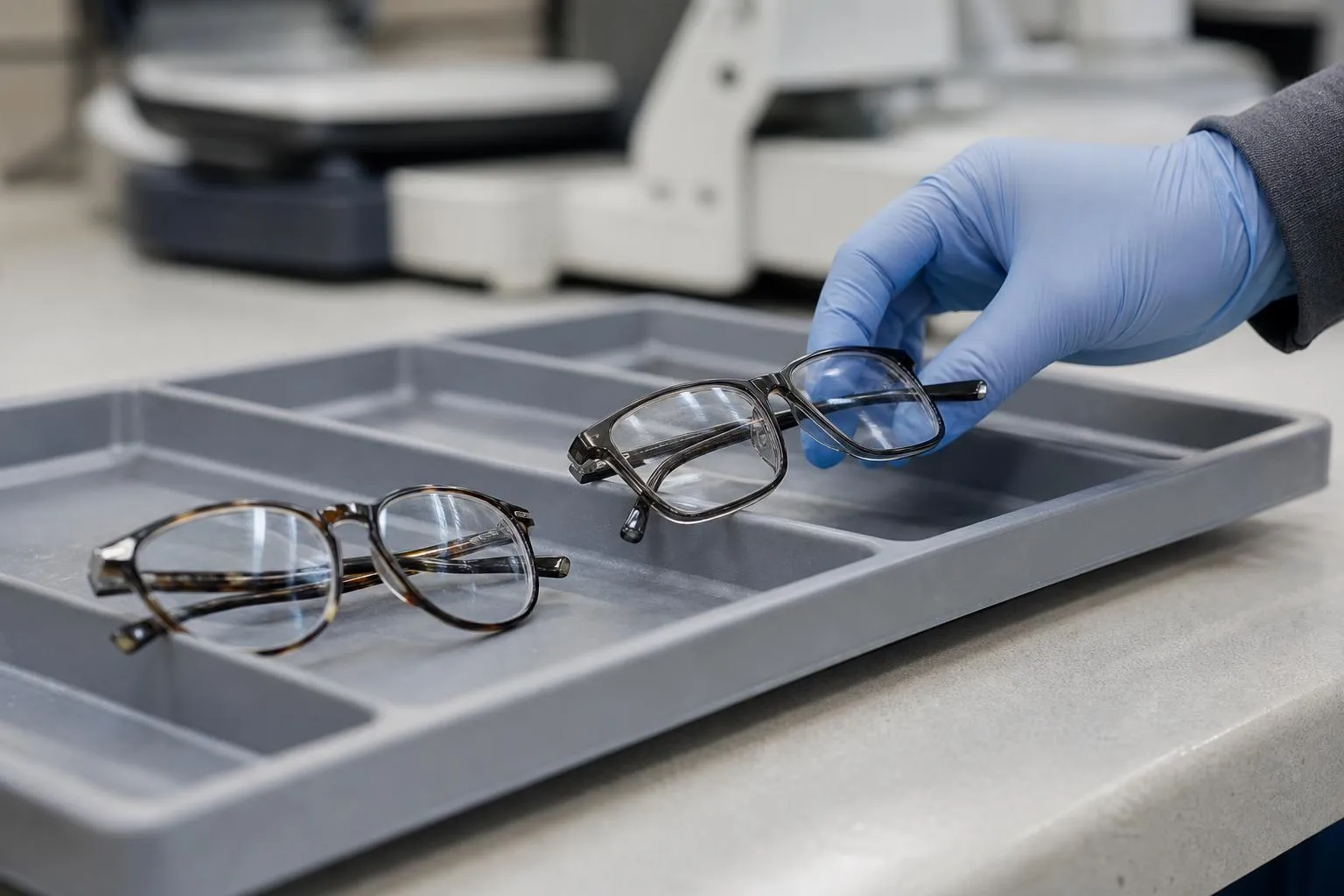
Which lens material for which prescription and frame?
Match the material to the strength of the prescription first, then let the frame and the wearer overrule it where they need to.
- Mild prescriptions: CR-39. It has the best Abbe value in our table, and at low power its extra thickness is small.
- Moderate prescriptions: 1.57 mid-index, thinner than CR-39 without going to the 1.67.
- Strong prescriptions: 1.67 high-index. It cuts the edge thickness of a strong minus lens and the centre thickness of a strong plus, and its Abbe value of 33 is a little better than polycarbonate’s 30.
- Children, sports and safety wear: polycarbonate, the impact-resistant choice of the three and the lightest in the table. For a patient with sight in one eye, it protects the good eye.
- Drill mounts and rimless: polycarbonate or 1.67. CR-39 is more likely to crack around the drill holes.
- Large frames: the bigger the lens, the more a strong prescription’s thickness shows. A 1.67, or a smaller frame, helps.
The trade to watch is polycarbonate on a strong prescription. It is light and tough, but its Abbe value is the lowest in the table, and a strong prescription is where that shows. A thin lens with coloured edges is still the wrong lens.
When a patient comes back with colour at the edges, check the material before the prescription. A switch from polycarbonate to CR-39 or 1.67 can fix it without touching the numbers.
At ITFIT: we edge and drill in our own lab, drill mounts and grooved rimless included. Put the frame type on the order along with the material.
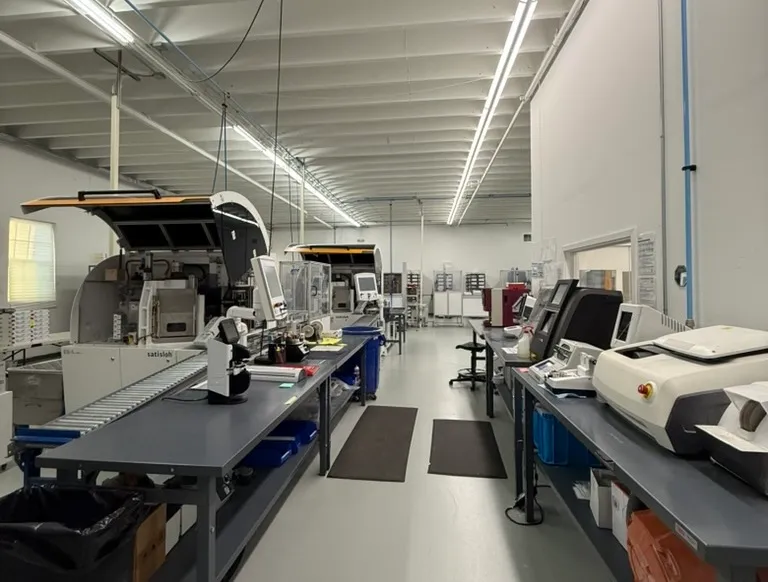
Does high-index need anti-reflective coating?
Yes, a 1.67 lens needs AR more than a CR-39 one does, because a higher-index surface reflects more of the light that hits it. Without AR, a patient pays for a thinner lens and gets more glare and more visible reflections with it.
Polycarbonate’s surface is soft, so it needs a scratch-resistant coat as well.
At ITFIT: our Green anti-reflective coating carries a one-year warranty against coating failure. The rest of our coatings and tints are done in-house too.
Abbe value decides what the patient sees at the edge of the lens, and index and specific gravity decide how thick and heavy it is. All three come with the material you put on the order, before the job is cut.
To send your next job with the material on it, open an account through VisionWeb.
Questions
What is a good Abbe value for eyeglass lenses?
Higher is better. Of the materials in our table, CR-39 has the highest at 59.3, 1.67 high-index has 33 and polycarbonate has 30. On a mild prescription the difference is hard to see. On a strong one it can show at the sides.
Is polycarbonate lighter than high-index?
For the same volume, yes. Polycarbonate's specific gravity is 1.20 against 1.35 for 1.67 high-index. On a strong prescription the 1.67 lens is thinner, so the weights come closer.
Which lens material is best for children?
Polycarbonate, for its impact resistance and low weight. Its Abbe value of 30 is the lowest in our table, which matters most on strong prescriptions.
Which material works for drill-mount rimless frames?
Polycarbonate or 1.67 high-index. CR-39 is more likely to crack around the drill holes.
Does ITFIT stock mid-index lenses?
Yes. We cut 1.57 mid-index, along with CR-39, polycarbonate and 1.67 high-index.
What causes coloured edges in a patient's glasses?
Often chromatic aberration. A low-Abbe material, a strong prescription and a patient looking away from the optical centre add up to it. A higher-Abbe material or better-centred lenses cut it down.