
Michelle JonesPublished Updated 6 min read
A patient comes back eight months after pickup. The lenses look hazy, and under the light there’s a fine web of cracks, or a patch where the coating has lifted at the edge.
Is it the lab’s coating or the patient’s dashboard? The answer decides whose problem it is. This guide covers anti-reflective coating lenses from the ordering side: what the layers do, what sits under them, how to tell a failure from damage, and what to write on the order.
What does an anti-reflective coating do on a lens?
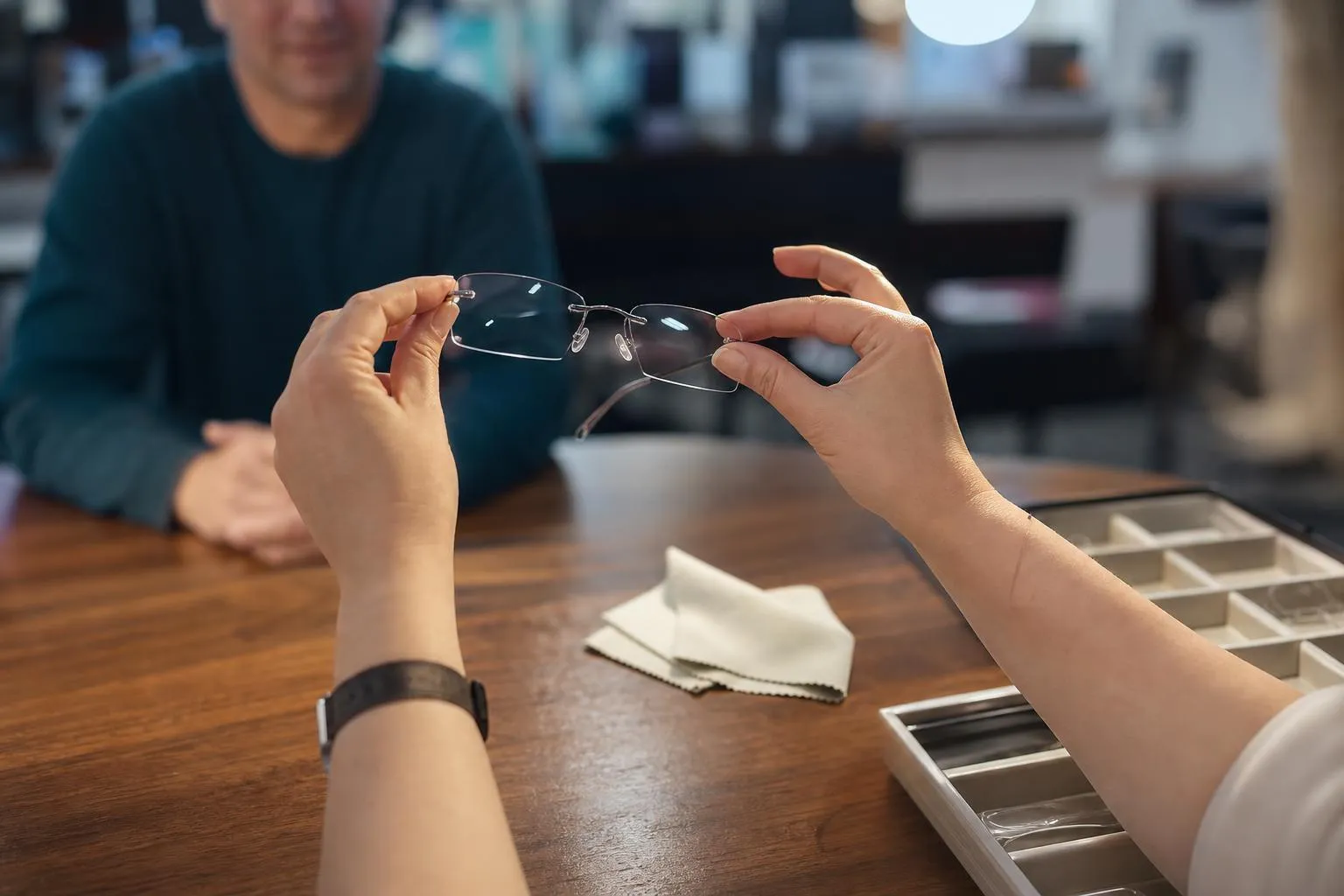
An anti-reflective coating cuts the light each lens surface reflects, so more light reaches the eye and less shows up as glare, ghost images and reflections on the lens.
An uncoated surface reflects a share of the light that hits it, and the share rises with the refractive index. For light arriving straight on, the Fresnel equation gives it as ((n-1)/(n+1))², where n is the index. A lens has two surfaces, so it pays twice.
A single layer cancels reflection best at one wavelength, when its optical thickness is a quarter of that wavelength. A stack of layers in different materials spreads the cancelling across the visible spectrum. The faint colour left in the reflection is the band the stack cancels least.
At ITFIT: the layers go on in our coating chamber, a step covered in how a progressive is made. These are the figures for the materials we cut, before any coating:
| Material | Index | Reflected per surface | Lost to reflection, both surfaces |
|---|---|---|---|
| CR-39 | 1.50 | 4.0% | 7.8% |
| 1.57 mid-index | 1.57 | 4.9% | 9.6% |
| Polycarbonate | 1.59 | 5.2% | 10.1% |
| 1.67 high-index | 1.67 | 6.3% | 12.2% |
Why do anti-reflective coating lenses need a hard coat under them?
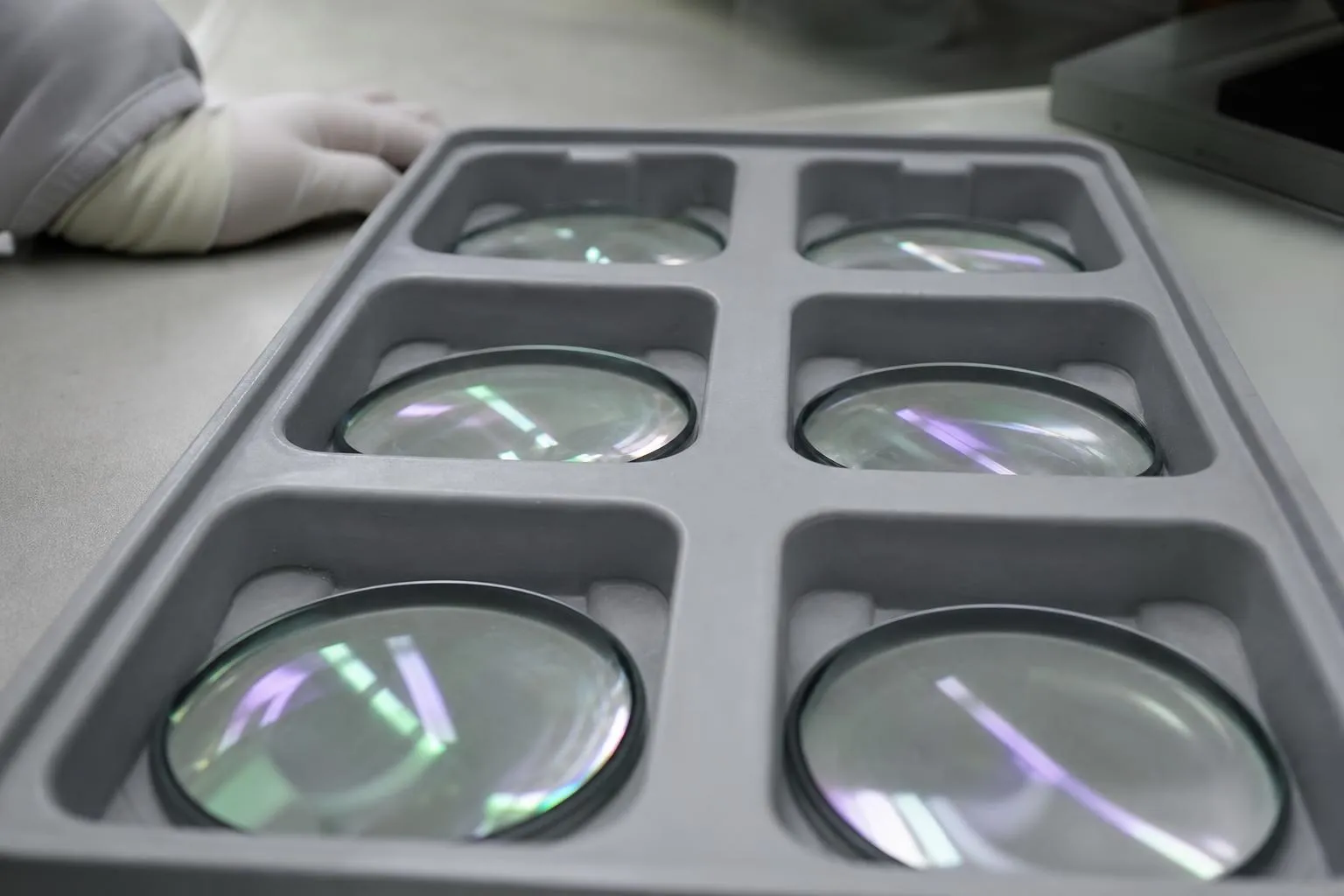
They need one because AR layers are thin and brittle, and the plastic lens under them is softer, flexes more and expands more when it warms. The hard coat gives the layers a firmer base than bare plastic.
Warm a coated lens enough and the plastic expands further than the layers on it can stretch. The layers crack in a fine web called crazing.
On a high-index lens, a hard coat whose index differs from the lens under it can show faint rainbow bands, called interference fringes. Hard coats for high-index lenses are made to match the lens’s index for that reason.
Why coat AR lenses in the lab that cuts them?
A lens coated in the building that cut it makes no extra trips and waits on nobody else’s schedule.
A lens sent to another lab for AR makes two extra trips. Each one is a chance for a scratch, a mix-up or a lost day.
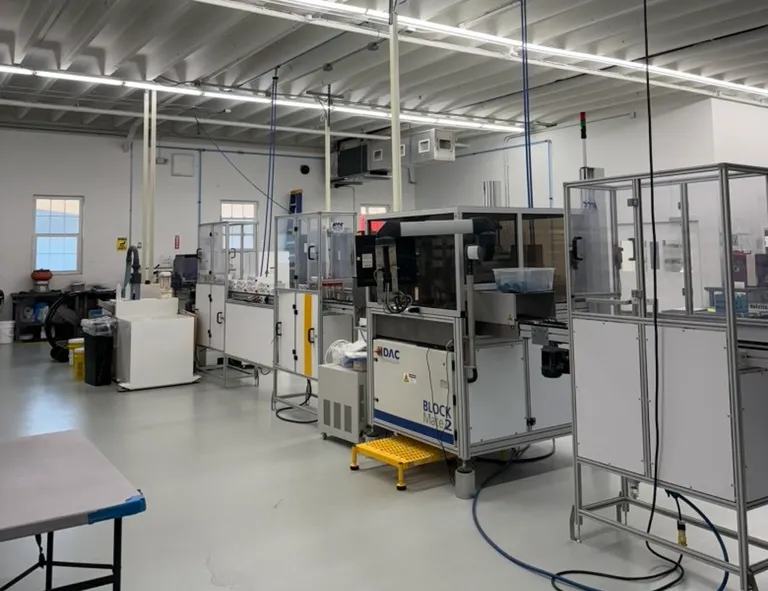
At ITFIT: we do everything in-house and don’t send lenses out to be coated. Our AR goes on in a Satisloh SP-200 in our coating room, and the lens goes from there to edging in the same building. Our Green AR carries a one-year warranty against coating failure, and if the coating fails inside the year, we replace it.
Is it AR coating failure or a scratch?
You tell them apart by the pattern: a coating failure shows the layers letting go of the lens, and damage follows the way the glasses were handled.
Heat damage shows as crazing: a fine web of cracks, clearest under a bright light, from a car dashboard, a hot tub, a sauna or a hairdryer. A coating failure shows as peeling or delamination, often starting at the edge, where the layers lose their bond with each other or with the lens.
Scratches are separate lines or arcs, from grit dragged across the lens or the lens set down face first. Fine swirls where the patient wipes are cleaning wear, from dry wiping, paper tissues or a dirty cloth.
At ITFIT: crazing and a coating that has let go can look alike on the bench, so ask the patient where the glasses have been. Send the pair in with the job number and what they told you, and a coating failure inside the year falls under the Green AR warranty.

How should patients care for anti-reflective coated lenses?
Tell patients to rinse before wiping, keep the glasses away from heat and harsh cleaners, and store them in a hard case. The notes below are written for you to pass on.
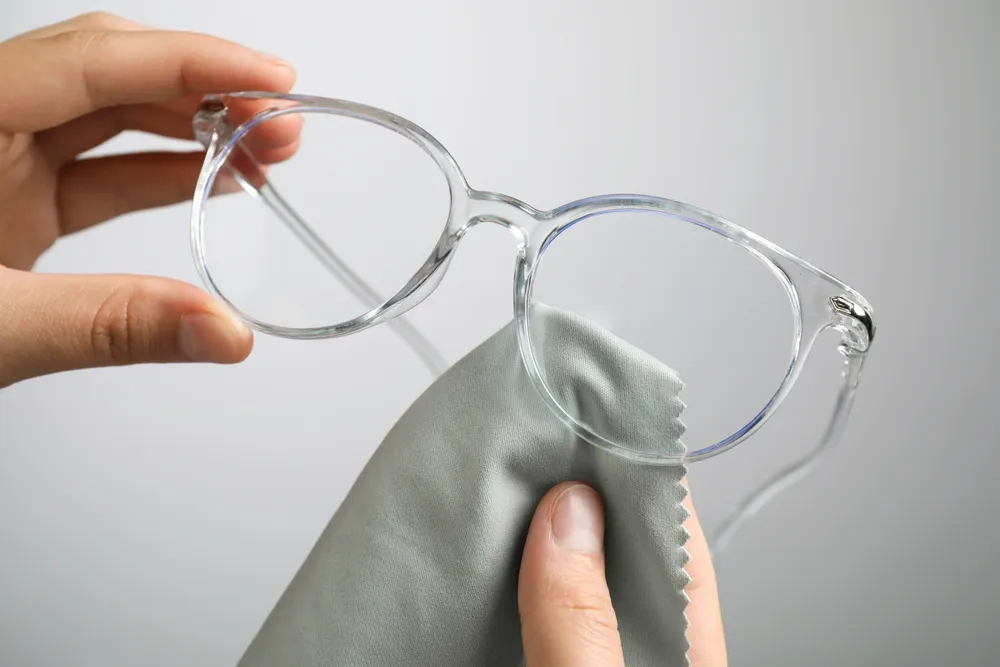
Most coating damage comes from grit already on the lens, dragged across it by the cloth. The routine to pass on is lukewarm water, a drop of mild dish soap rubbed on each side with the fingertips, a rinse, then a clean microfibre cloth to dry.
Keep the glasses off a summer dashboard and out of the sauna, because crazing from heat doesn’t go away. Glass cleaner often contains ammonia, which can damage the coating, and tissues and shirt tails are rougher than they feel. Wash the microfibre cloth every couple of weeks, without fabric softener, which leaves a film.
What should go on an AR lens order?
Put everything the lens gets on one order, so it’s made once in the right sequence.
- The coating by name. Green AR, so there’s no question which treatment the lens gets.
- The material. A high-index lens has the most to gain, as the table above shows. The lens material guide covers the rest of that choice.
- Tint, mirror or polarized, on the same job. The tint has to go in before the AR, and one order keeps the lens moving through the lab in one line.
- Back-surface AR on sun lenses. Behind a dark tint, the reflections that bother the wearer come off the back surface, from light behind them. AR on the back takes those out.
At ITFIT: tints, mirrors, polarized and photochromic lenses are made here, along with scratch-resistant and blue light blocking coatings, and we keep a clean room for sunglass tints. Ask for prices through lab pricing.
AR is a stack of thin, brittle layers on a softer lens, and heat and handling cause most of the damage you’ll see. Put the whole lens on one order, and pass the care notes to the patient at pickup.
To order AR from the lab that cuts the lens, open an account through VisionWeb. New accounts get their first two jobs free.
Questions
What does ITFIT's AR warranty cover?
Our Green AR carries a one-year warranty against coating failure. If the coating fails inside the year, we replace it.
What is crazing on an AR lens?
A fine web of cracks in the coating, usually from heat. The plastic lens expands further than the coating layers on it can stretch, and the layers crack.
Why does an AR lens still show a faint coloured reflection?
The layers cancel some wavelengths better than others. The colour you see is the band the stack cancels least.
Should sunglasses have AR?
On the back surface, yes. Behind a dark tint, light from behind the wearer bounces off the back of the lens into the eye, and AR there takes it out.
Can a tinted lens be AR coated?
Yes. The tint goes in first and the AR over it, so put both on the same order.
What should a patient clean AR lenses with?
Lukewarm water, a drop of mild dish soap and a clean microfibre cloth. Rinse first, so grit is washed off before anything wipes across the coating.
Is AR done in-house at ITFIT?
Yes, on a Satisloh SP-200 in our own building, along with surfacing, tints and edging.