
Progressive lens identifier: reading the markings
How to turn the faint marks on a patient's progressive into a design name, find its fitting cross, and decide what to order when nothing reads.

John AldersPublished 7 min read
A new patient sits down in progressives they like and wants the next pair to feel the same. Nobody has a record of the lens: the last practice closed, it was a second pair from somewhere else, or another lab made it as a remake.
The design decides where the fitting cross sits and how long the corridor runs, so find out what the patient is wearing before you reorder. A progressive lens identifier turns the faint marks on the lens into that design’s name.
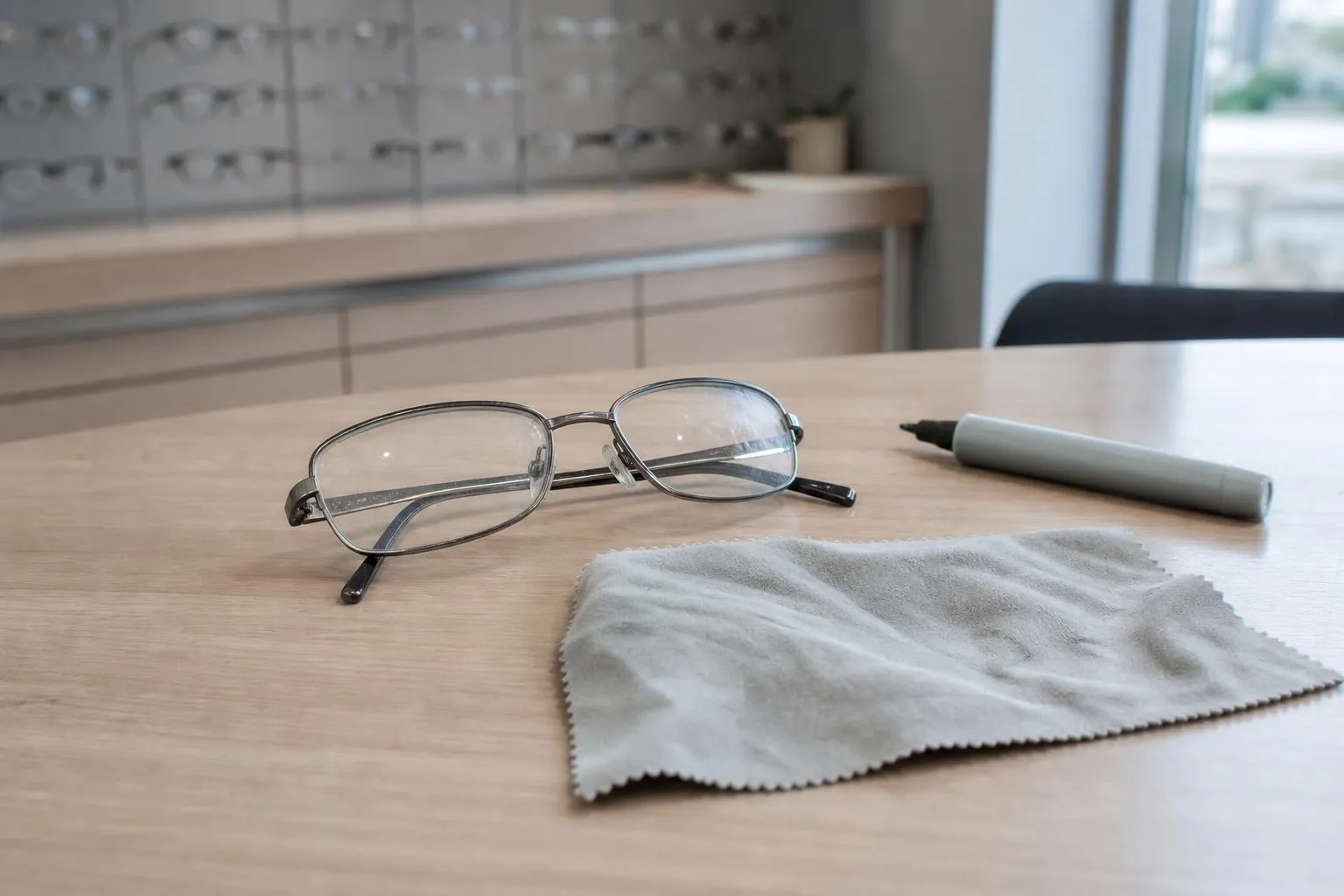
Why identify a progressive lens before you reorder?
Identify it because the design sets the layout the patient got used to: where the fitting cross sits, how long the corridor runs, how wide the reading area is and how far it’s set in toward the nose. Keep the design and you keep that layout. Change it, and the patient can notice, even when every measurement is right.
A patient who was happy in the old pair should keep that layout. For one who wasn’t, the design is one of the things to change, and our guide to non-adapts shows how to tell a design problem from a measurement problem.
At ITFIT: when a patient can’t adapt to a progressive we made, we redo the job. Starting from the design the patient already likes is the easier way to avoid that second visit.
Where are the markings on a progressive lens?
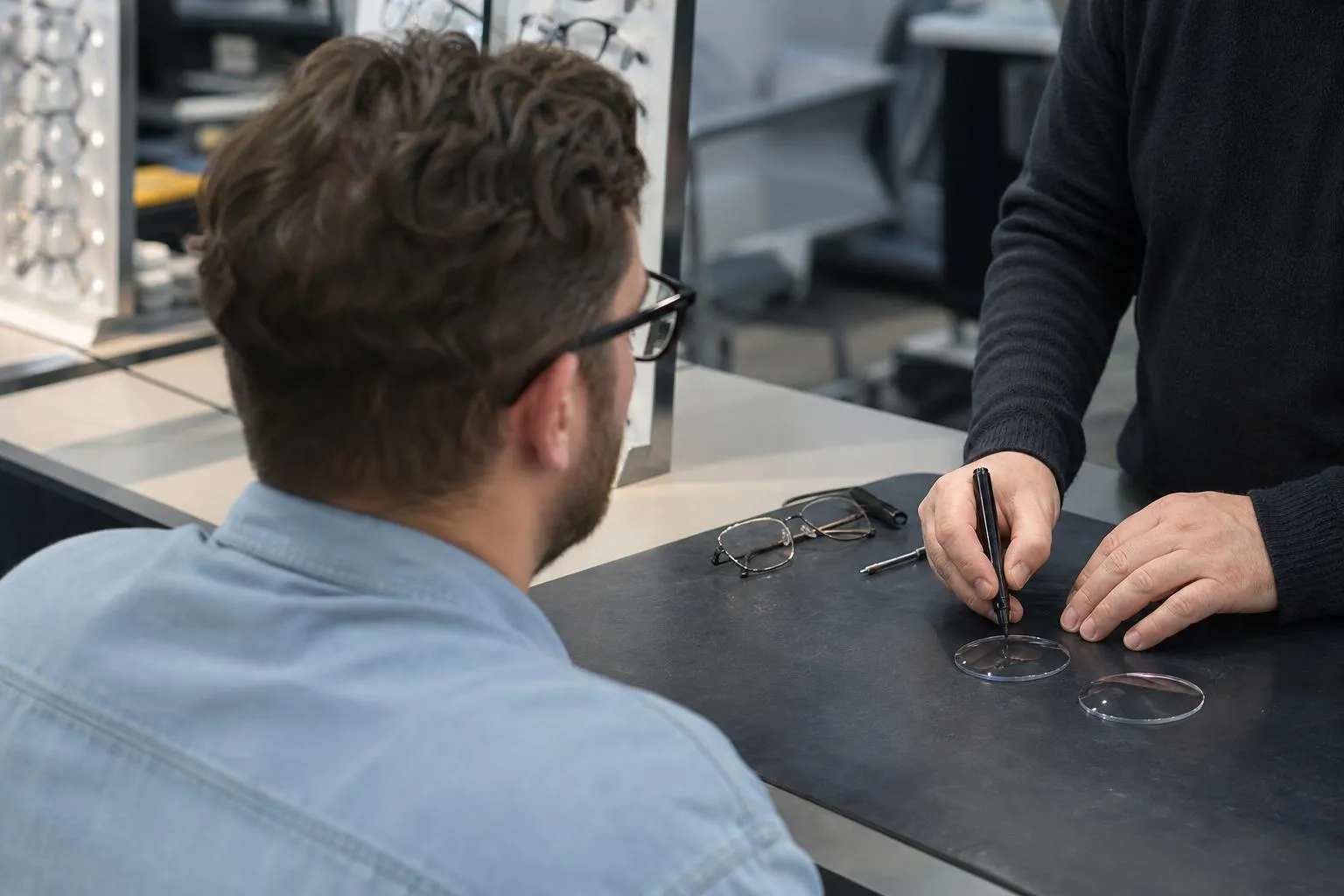
The markings are two faint permanent engravings, level with each other, one each side of the lens, with small characters underneath. The lensometer guide covers how to make them show up under a light. Dot each engraving with a fine marker, because the rest of this guide is measured from those two dots.
Find no engravings at all, and check the lens is a progressive before going further. On the lensometer, a progressive gains plus as you move down from the distance zone. A single vision lens reads the same power across the lens, and only the prism changes as you move off centre.

What do the engravings on a progressive lens tell you?
They tell you up to three things: the design or its maker, the add, and on some lenses the material.
| Mark | Where it usually sits | What it tells you |
|---|---|---|
| Two matching symbols: circles, logos or letters | On a horizontal line, one each side | The lens’s horizontal, the prism reference point halfway between, and often the maker |
| A short number | Under the temporal symbol | The add |
| A letter, number or small logo | Under the nasal symbol | The design, the maker or the material |
The add sits on the temporal side, so on a lens out of its frame it shows which side faces the temple. With the front surface known, that tells you right from left.
The engraved add is the design’s label. On a compensated free-form lens the add measured at the near circle can differ from it, so record both. If the two lenses carry different engraved adds, check the prescription: either the prescriber asked for unequal adds or the lenses came from two pairs.
How do you use a progressive lens identifier chart?
You match the lens’s engravings against the chart: the maker’s own chart for its designs, or The Vision Council’s Electronic Progressive Identifier Catalog (EPIC), which covers over 500 designs sold in the US and Canada.
Match more than the logo. Designs from one maker can share a symbol and differ only in the mark under the nasal engraving, so check that mark, check that the engraved add is one the design is offered in, and check the material if the chart lists it.
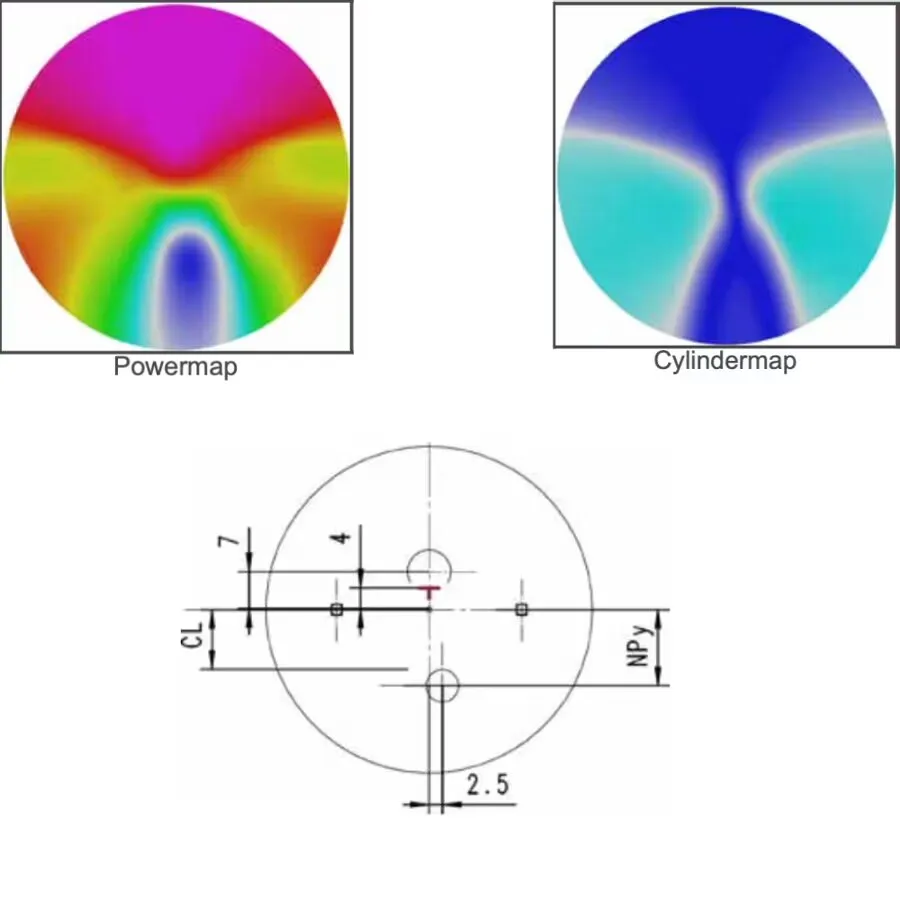
A match gives you the design name, the maker and a drawing of the layout: where the fitting cross, distance circle, prism reference point and near circle sit against the engravings. Many charts add the minimum fitting height.
A lens clock settles a tie between a front-surface design and a back-surface one. On a front-surface design the front curve steepens from the distance zone to the near zone. On most back-surface free-form lenses the front is a sphere and reads the same in both zones.
At ITFIT: if you think the old pair came from our lab, call customer support on 561-938-4644 before you reach for a chart.
How do you find the fitting cross from the engravings?
Measure up from the midpoint between the two engravings, by the distance the chart gives for that design. The midpoint is the prism reference point, and on many designs the fitting cross sits above it. The lensometer guide has the steps for re-marking the whole lens from a centration chart.
How far above varies from design to design, and so does how far the near circle is set in toward the nose. Take both figures from the chart for the design you matched. One design’s figures used on another put the cross in the wrong place, and every reading after that is off.
With the cross marked, the old pair becomes a measuring tool: put it on the patient, adjusted, and see where the cross sits against the centre of the pupil.
Measure from the cross down to the lowest point of the lens opening, and you have the fitting height the lens was mounted at. Measure from the cross to the centre of the bridge, and you have the monocular PD. If the patient keeps the frame, those numbers are a direct check on yours; in a new frame, measure fresh.
What should you order after you identify a progressive lens?
Order what the marks support: the same design when you found it and the patient liked it, and a new design, measured fresh, when you found less. With the design, maker and add found and the cross marked, check the old fit on the patient first. With only the add, confirm it on the lensometer and order as a new design.
When nothing reads, order a new pair with every measurement taken fresh: monocular PDs and fitting heights in the adjusted frame, and a frame tracing. Don’t copy a fitting height from a lens you can’t identify. Without its design you don’t know where its fitting cross was, so a copied height is a guess with a number on it.
Ask the patient instead where they hold a book, how many hours they spend at a screen, and what they liked and disliked in the old pair. Put the answers on the order.
At ITFIT: we make our own designs and don’t carry outside brands, so we can’t make the exact branded lens a patient wore before. For a patient open to a new design, ours is a free-form progressive engineered in Germany, described on our lenses page. Tell the patient it’s a different design before they collect the glasses.
Those two faint engravings carry the layout your patient already knows. Read them before you reorder, and the next pair starts from there.
To send us the order, open an account through VisionWeb. New accounts get their first two jobs free, and we redo non-adapts.
Questions
What is a progressive lens identifier?
A chart, book or app that lists progressive designs by their engraved marks, with a drawing of where each design's reference points sit against those marks.
Where is the add engraved on a progressive?
Under the temporal engraving on most designs, as a short number. Because it sits on the temple side, it also tells you which way round a lens goes once it's out of the frame.
Can you tell a front-surface progressive from a back-surface one?
A lens clock can. On a front-surface design the front curve steepens from the distance zone to the near zone. On most back-surface free-form lenses the front is a sphere and reads the same at both points.
Can two progressive designs share the same engraving?
Designs from one maker can share a logo. Match the mark under the nasal engraving, the add and the layout as well before you name the design.
Is the fitting cross the same distance above the engravings on every design?
No. The distance varies by design, and so does the inset of the near circle. Take both from the chart for the design you matched.
Should you copy the fitting height from a patient's old pair?
Only as a check, and only once the design is known and its fitting cross is marked. In a new frame, measure fresh.
Can ITFIT make the same branded design a patient wore before?
No. We make our own designs and don't carry outside brands. Our progressives use a free-form design engineered in Germany.